
For most e-commerce teams, scaling feels like the natural next step. Traffic is working, acquisition channels are stable, and there is enough momentum to justify increasing spend and pushing for growth. The underlying assumption is straightforward: if more users enter the funnel, more of them should convert.
But in practice, this is rarely what happens.
As traffic increases, conversion often begins to decline. Acquisition costs rise, performance becomes inconsistent across channels and devices, and what once felt like a predictable growth system starts to feel unstable. Initially, this is often attributed to traffic quality or campaign performance. However, over time, a different pattern becomes visible.
Growth isn’t failing. It is exposing something that was already there.
Scaling Doesn’t Improve Your Funnel — It Tests It
At lower volumes, funnels operate under relatively controlled conditions. Users tend to arrive with higher intent, greater patience, and a stronger willingness to navigate minor friction or ambiguity. Under these circumstances, even a journey that lacks clarity can perform reasonably well because users compensate for its weaknesses.
As traffic increases, however, the composition of users changes. You begin to see:
INTENT
A wider range of intent levels
EXPECTATIONS
Different expectations from the experience
TOLERANCE
Lower tolerance for confusion or effort
What once worked under ideal conditions is now being tested under real conditions.
The Core Question: Can Your Funnel Respond to Variability?
At the heart of scaling lies a more fundamental question than most teams ask: can the funnel respond consistently to different types of users?
A strong funnel is not optimized for a single scenario. It is designed to support decision-making across variation—whether the user arrives with high intent or low, from mobile or desktop, through paid traffic or organic discovery. Clarity does not depend on context; it persists across it.
When this responsiveness is missing, performance becomes fragile. You begin to see:
— Conversion fluctuating unpredictably
— Drop-offs shifting across stages
— Results becoming harder to stabilize
This is the point where scaling begins to break down—not because the traffic is poor, but because the system cannot support it.
The Clearest Signs Your Funnel Isn’t Ready To Scale
These signs are often treated as separate issues, but in reality they are connected. Each one reflects a different way in which the funnel struggles to handle increased variability and complexity.
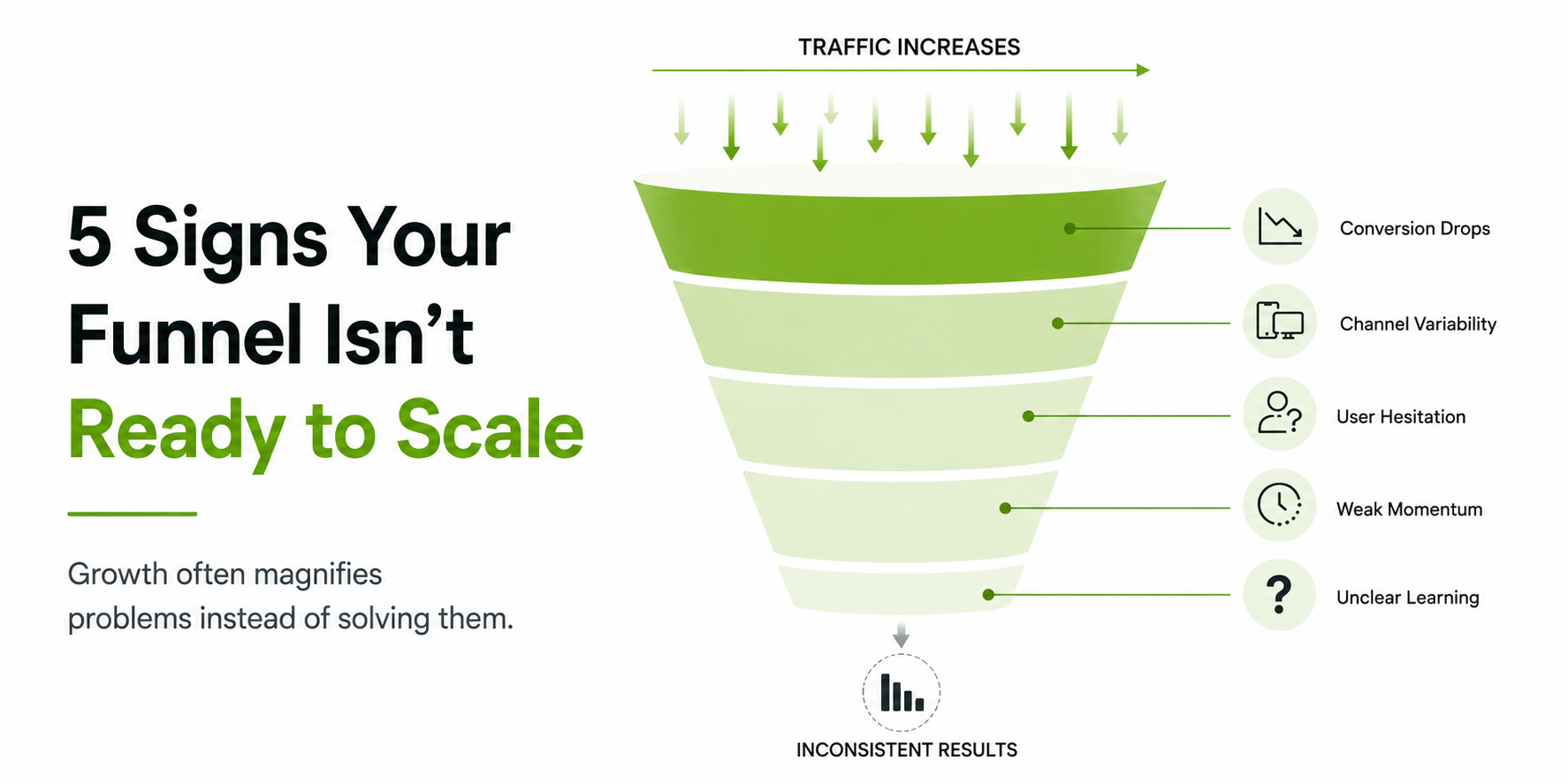
1. Conversion drops as traffic increases
One of the most direct indicators of a readiness issue is a consistent decline in conversion as traffic scales. As reach expands, the average level of user intent typically decreases, and users require greater clarity and guidance to move forward
— Strong performance at lower traffic levels
— Gradual decline as campaigns scale
— Increasing dependence on high-intent users
This is not simply a matter of audience quality. It is a signal that the journey itself is not robust enough to support a broader user base.
2. Performance varies across devices, segments, or channels
A scalable funnel should behave consistently across contexts. When performance differs significantly between mobile and desktop, paid and organic traffic, or across user segments, it suggests that the experience is not uniform.
In effect, the business is operating multiple funnels without realizing it—some functioning effectively, others underperforming.
Given the dominance of mobile commerce, data from Statista continues to highlight how critical cross-device consistency has become. A funnel that fails in one major context cannot scale efficiently.
3. Users hesitate at key decision points
Not all friction impacts performance equally. The most critical moments occur where users are required to make decisions—evaluating a product, adding it to cart, or completing a purchase.
When hesitation appears at these points, it usually shows up as:
— Repeated back-and-forth behavior
— Delayed actions before clicking
— Increased drop-offs at key steps
Users may not fully understand the value, may feel uncertain about the next step, or may perceive the process as requiring more effort than expected.
Research from Baymard Institute consistently shows that even small inefficiencies in checkout can lead to significant abandonment rates. At scale, these moments do not just reduce conversion; they compound loss across the entire funnel.
4. Improvements don’t sustain or compound
Another important signal is how the funnel responds to change. In a stable system, improvements tend to build on one another. Gains are reinforced over time, and performance becomes more predictable.
In a fragile system, however, improvements are often short-lived. A change may produce a temporary lift, but the effect stabilizes or diminishes quickly.
— Quick wins that fade over time
— Improvements that don’t translate across pages
— Gains that fail to compound
This is often interpreted as diminishing returns, but in many cases it indicates that deeper structural issues remain unresolved. When the foundation is weak, surface-level improvements cannot sustain momentum.
5. Testing and optimization feel inconsistent
When a funnel is not ready, experimentation becomes unreliable. Teams observe conflicting test results, improvements that fail to replicate, and outcomes that are difficult to explain.
This often looks like:
— Winning tests that don’t repeat
— Losing tests without clear reasoning
— No clear pattern of learning
As discussed in → When CRO Fails Before It Starts, this inconsistency is rarely a failure of testing methodology. It is a consequence of unstable user behavior. When different users experience the funnel differently, experiments cannot produce clear or reliable signals.
Without consistent behavior, there can be no consistent learning.
What These Signs Actually Point To
While these issues may appear distinct, they share a common root. They are all expressions of a single underlying problem: the funnel lacks structural clarity.
Users are not moving through the journey with confidence and continuity. Instead, they encounter hesitation, ambiguity, and friction at multiple points.
— At lower scale, these issues may be absorbed.
— At higher scale, they become constraints.
What “Ready to Scale” Actually Means
A funnel that is ready to scale is not defined by perfection, but by stability. It guides users clearly from entry to conversion, maintains consistency across devices and channels, and supports decision-making without unnecessary effort.
In practice, this means:
✓ Users understand what to do at every step
✓ Transitions between stages feel natural
✓ Messaging reinforces decisions instead of creating doubt
✓ Behavior becomes predictable and measurable
In such systems, growth does not reduce efficiency. It reinforces it.
What Needs to Happen Before You Scale
Before increasing acquisition efforts, the priority should be to understand how the funnel behaves under pressure.
This involves:
→ Identifying where users hesitate
→ Understanding why decisions break down
→ Prioritizing structural improvements over surface fixes
Rather than asking what to optimize next, the more useful question becomes whether the system itself is capable of supporting growth.
This is where a → Funnel & Journey Audit plays a critical role. It provides a clear view of how the funnel functions as a whole, allowing teams to address foundational issues before attempting to scale.
FINAL THOUGHT
Scaling does not create performance. It reveals it.
If the funnel is clear and stable, growth becomes more efficient as traffic increases. If it is not, growth becomes more expensive and less predictable.
The difference is not effort. It is readiness.