
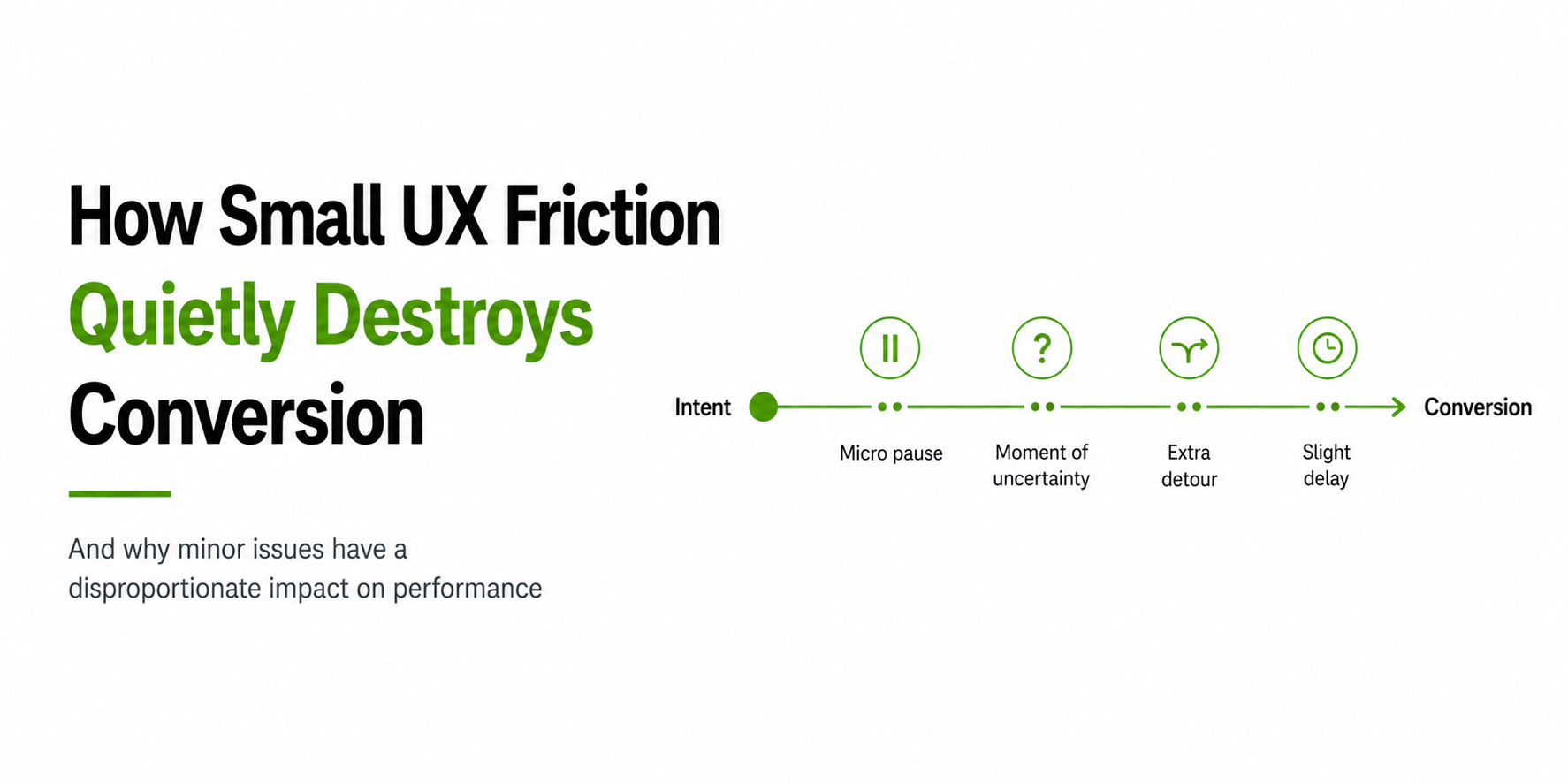
One of the most misleading assumptions in e-commerce is that only major problems affect conversion.
Teams look for obvious issues — broken pages, missing features, significant usability gaps. And when nothing appears clearly wrong, the funnel is assumed to be functioning as expected.
But in many cases, conversion suffers even when nothing is visibly broken.
Most Friction Doesn’t Look Like a Problem
Instead, it appears in subtle ways:
— A button label that isn’t immediately clear
— A product description that requires effort to understand
— A slight delay in page load
— A step in checkout that feels unnecessary
What “Small Friction” Actually Looks Like
It shows up in moments where users are required to pause, think, or expend more effort than expected.
For example:
— A user lands on a product page but has to scan multiple sections to understand the value
— Navigation requires extra steps to reach a relevant category
— Product comparisons are not intuitive, forcing users to switch between pages
— Checkout introduces fields or decisions that were not anticipated
Why Small Friction Compounds Into Major Loss
A user may encounter:
EVALUATION
Slight uncertainty while evaluating a product
A small delay before taking the next step
CHECKOUT
A bit of extra effort during checkout
Each interruption introduces a pause. Each pause creates an opportunity for doubt. And as these pauses repeat, the journey begins to feel effortful rather than natural.
Research from Google has shown how even small delays in page load time can reduce conversion rates. While this is often viewed in isolation, the more important insight is how multiple small inefficiencies interact.
How Friction Creates Hesitation
Friction does not just slow users down. It changes how they make decisions.
When the journey is smooth, users move forward with confidence. Each step reinforces the previous one, and momentum builds naturally.
When friction is introduced, that momentum breaks.
- A moment of confusion leads to a pause
- A pause leads to reconsideration
- Repeated pauses lead to hesitation
This is why even high-intent users fail to convert. Their intent is not the issue — the experience is.
As explored earlier in Why Users Hesitate Even When They’re Ready to Buy, hesitation is often a response to unresolved friction rather than lack of interest.
Why Small Friction Gets Ignored — and Why That Hurts Performance
Despite its impact, small friction rarely receives focused attention.
There are a few reasons for this:
— Each issue appears minor and easy to dismiss
— Problems are distributed across the funnel rather than concentrated
— The connection between friction and revenue impact is not immediately visible
Because of this, teams tend to prioritize what feels more significant or actionable.
→ Larger redesigns or feature additions
→ Individual page improvements
→ New campaigns or acquisition channels
→ Small friction distributed across the funnel
→ Compounding interruptions to flow
→ The overall experience users actually feel
What Reducing Friction Actually Means
In reality, it is more precise than that.
It means identifying what interrupts decision-making and removing or refining it.
This could involve:
✓ Making product value clearer at a glance
✓ Structuring content so users don’t have to search for key information
✓ Ensuring transitions between steps feel natural and expected
✓ Removing unnecessary effort from high-intent moments like checkout
What This Means for Your Funnel
Not because any single issue is critical, but because the overall experience requires more effort than it should.
Understanding this requires shifting perspective.
From
“What’s wrong with this page?”
To
“Where is the journey slowing down, and why?”
Looking at the funnel this way reveals patterns that are otherwise easy to miss — patterns that only become visible when the journey is considered as a system rather than a collection of parts.
FINAL THOUGHT
It slows it down.
And when a journey slows down enough, it stops.
That is how minor issues, left unaddressed, quietly destroy performance.
Not through failure — but through accumulation.