
For many e-commerce teams, the signs of a problem are not dramatic.
There is no sudden crash in performance. No single page that is clearly broken. Traffic continues to flow, campaigns are running, and users are engaging with the site.
And yet, conversion underperforms.
At this stage, the instinct is often to look for isolated issues—fix a page, improve a section, test a variation. But over time, it becomes clear that nothing fundamentally changes.
Most Funnels Don’t Fail — They Lose Momentum
When we think of a “broken” funnel, we imagine something clearly wrong—a page that doesn’t load, a button that doesn’t work, or a major usability issue.
But in reality, most funnels function well enough to avoid obvious failure.
Users can navigate the site. They can view products. They can even begin the checkout process.
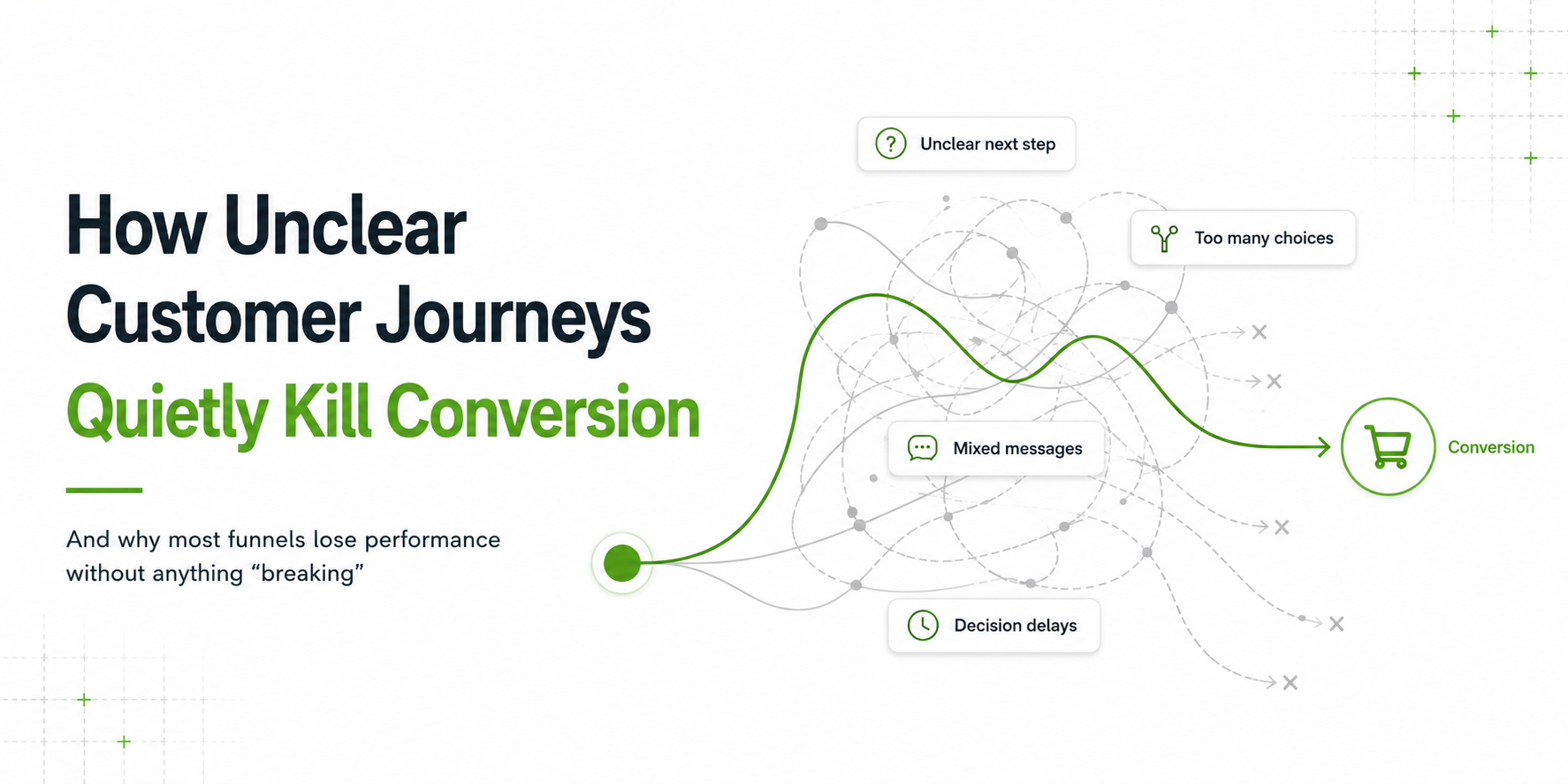
The issue is not that the journey is unusable. It is that it is unclear. And when clarity is missing, users don’t stop immediately. They slow down. They pause. They reconsider. They lose momentum. This loss of momentum is subtle, but it is what ultimately impacts conversion.
What an Unclear Journey Actually Looks Like
The issue is not disorder—it is lack of guidance.
Users may experience:
How Unclear Journeys Affect User Behavior
When a journey lacks clarity, the impact shows up in behavior before it shows up in metrics.
Users begin to:
— Spend more time deciding, but not progressing
This connects directly to what we explored in → Why Users Hesitate Even When They’re Ready to Buy
Hesitation is not just a behavioral quirk. It is a response to uncertainty. And in unclear journeys, that uncertainty is constant.
The Real Cost of Unclear Journeys
Lost conversions you never see
Not every lost conversion is obvious. Some users leave immediately. Others get very close to converting before dropping off. These users:
— Viewed products
— Engaged with content
— Considered a purchase
Because they never reached the final step, these losses often go unexamined. They are treated as normal behavior rather than missed opportunity.
COST 02
Higher acquisition costs
When conversion is suppressed, the cost of acquiring customers increases. You are effectively paying for traffic that the funnel cannot convert efficiently. This creates a compounding effect:
— More spend is required to achieve the same revenue
— Margins tighten
— Scaling becomes less sustainable
The issue is not always the cost of traffic. It is the inefficiency of the system receiving it.
Poor performance of optimization efforts
Unclear journeys also limit the effectiveness of optimization. Teams may run experiments, redesign sections, or improve individual pages. But when the overall flow lacks clarity, these improvements struggle to deliver consistent results.
This is also why experimentation often struggles in such funnels — because without a clear journey, even well-designed tests fail to produce consistent learning, a problem we explored earlier in When CRO Fails Before It Starts.
Reduced customer lifetime value
The first experience a user has with your funnel shapes their perception of your brand. If that experience feels confusing, effortful, or uncertain, it affects more than just the initial conversion. Users are less likely to:
— Return for future purchases
— Develop trust in the brand
— Engage beyond the first interaction
Over time, this reduces not just conversion, but retention and lifetime value.
A Simple Example
They arrive on a category page with dozens of products, but no clear guidance on what makes one option better than another. Filters are available, but not intuitive. Product descriptions vary in depth and clarity.
The user clicks into a product, reviews details, then returns to compare with others. After a few cycles of this, they add an item to cart.
At checkout, they encounter:
What the user encounters at checkout
— Additional costs revealed late
— Multiple form fields
— Unclear delivery timelines
At no point does the journey “break.” But at every step, it requires effort. Eventually, the user leaves—not because they weren’t interested, but because the experience never felt easy enough to complete. This is how unclear journeys lose conversion.
Why These Costs Are Hard to Detect
One of the challenges with unclear journeys is that their impact is distributed.
There is no single metric that captures “lack of clarity.”
Instead, the effects are spread across:
Slightly lower conversion rates
Slightly lower conversion rates
Slightly longer decision times
Where Most Teams Go Wrong
They:
— Improve individual pages
— Add more content or features
— Increase promotional activity
What a Clear Journey Changes
It ensures that:
Users understand what to do at each step
Transitions between stages feel natural
Messaging reinforces decisions instead of complicating them
What This Means for Your Funnel
Understanding this requires looking beyond individual pages and examining how users move through the funnel as a whole.
This is where a Funnel & Journey Audit becomes valuable. It helps identify where clarity breaks down and how those breakdowns affect the overall system.
FINAL THOUGHT
They don’t break in ways that are easy to diagnose.
Instead, they quietly reduce momentum, slow decisions, and drain performance over time.
And until that clarity is restored, growth will always require more effort than it should.