
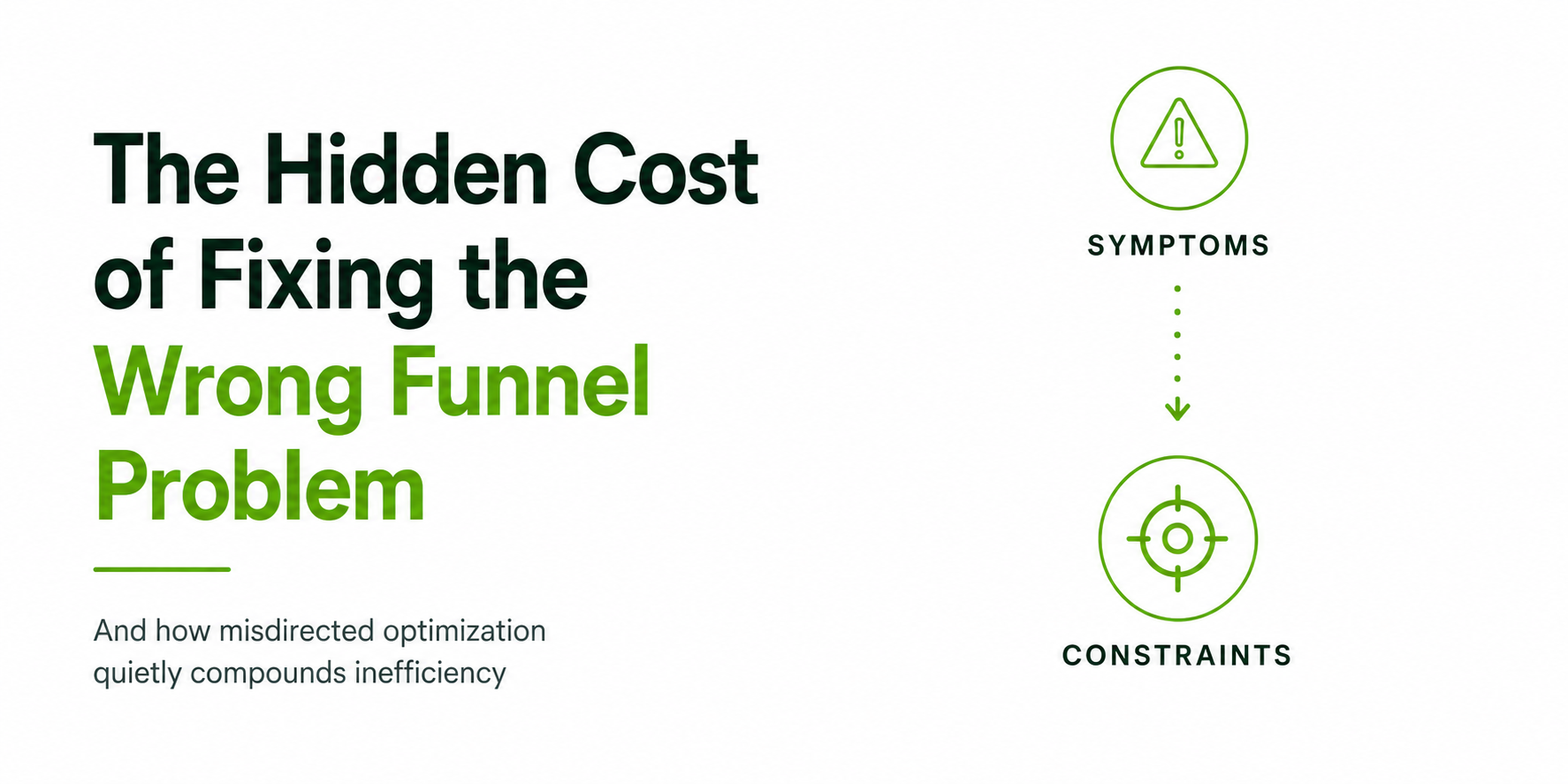
Most e-commerce teams are not short on effort.
They are constantly improving pages, testing variations, refining checkout flows, and launching new ideas. There is no shortage of activity, and in many cases, no shortage of intent either.
And yet, conversion often fails to improve in a meaningful or sustained way.
At some point, the question shifts from “What should we fix next?” to something more fundamental:
“Why aren’t these improvements working?”
Most Optimization Work Starts With the Wrong Question
A page looks weak. A section feels unclear. A drop-off appears in analytics. These become starting points for action.
But this approach is based on a flawed assumption: that what is visible is what matters most.
In reality, the most visible problems are often symptoms, not causes.
Why Fixing Things Doesn’t Always Improve Performance
SURFACE-LEVEL ISSUES
— A weak headline
— A confusing button label
— A suboptimal layout
→ Unclear decision paths
→ Misalignment between intent and experience
→ Breaks in journey flow
Surface-level issues are easier to identify and fix. Structural issues are harder to see, but far more influential.
What “Fixing the Wrong Problem” Actually Looks Like
For example:
What misdirected optimization looks like
— Improving the design of a product page when users don’t fully understand the product
— Running A/B tests on variations when the overall journey lacks clarity
— Optimizing checkout steps when hesitation begins much earlier in the funnel
Each of these actions makes sense in isolation. But if the core constraint lies elsewhere, they do little to improve overall performance. In some cases, they can even make the experience more complex by adding layers that don’t resolve the real issue.
Why This Happens So Often
Most teams rely on what is easiest to observe:
— Page-level metrics
— Drop-off points
— Isolated user behaviors
The Hidden Cost of Misdirected Optimization
COST 01
Wasted time and effort
COST 02
Misleading results
Changes may produce small or inconsistent improvements, leading to unclear conclusions. This makes it difficult to distinguish what is actually working from what is coincidental.
As discussed earlier in When CRO Fails Before It Starts, unreliable results are often a sign of deeper structural issues rather than poor experimentation.
Increased complexity
COST 04
Slower learning
How This Makes Your Funnel Worse
One of the less obvious effects of fixing the wrong problems is that it can degrade the overall experience over time.
Each isolated improvement introduces a new element, assumption, or variation. Without a clear understanding of how these changes interact, the funnel becomes less cohesive.
Users may encounter:
— Inconsistent messaging across steps
— Conflicting cues about what matters
— Additional effort in navigating the journey
This creates the kind of friction that does not come from a single issue, but from how multiple changes interact.
As explored in How Small UX Friction Quietly Destroys Conversion, these small inconsistencies compound, gradually slowing down the user’s progression through the funnel.
The Difference Between Symptoms and Constraints
SYMPTOMS
These are visible issues:
— Drop-offs at specific pages
— Low engagement in certain sections
— Poor performance of individual elements
Symptoms tell you where to look.
These are underlying limitations:
→ Lack of clarity in decision-making
→ Weak progression through the journey
→ Misalignment between user intent and experience
Constraints tell you what to fix.
What Effective Optimization Actually Looks Like
This involves:
✓ Identifying the points where users lose clarity or confidence
✓ Understanding how issues interact across the journey
✓ Prioritizing changes based on impact, not visibility
✓ Sequencing improvements so that each builds on the previous one
What This Means for Your Funnel
It may be that attention is being directed toward the wrong problems.
Understanding where the real constraints lie requires stepping back from isolated metrics and examining how the journey functions as a whole.
Only then does it become clear which changes will actually move the needle—and which ones will not.
FINAL THOUGHT
It consumes effort, distorts learning, and gradually makes the system more complex.
And over time, that complexity becomes its own barrier to improvement.
The goal of optimization is not to fix more things.
It is to fix the right ones.