
Conversion Rate Optimization (CRO) is widely treated as a growth lever.
Run experiments. Learn from results. Improve conversion. Scale what works.
In theory, this is sound.
In practice, many teams find themselves stuck in a different pattern:
— Tests run, but insights are unclear
— Results fluctuate without consistency
— Improvements fail to compound
At some point, the question shifts from “What should we test next?” to something more fundamental:
“Why isn’t this working?”
The answer, more often than not, is uncomfortable.
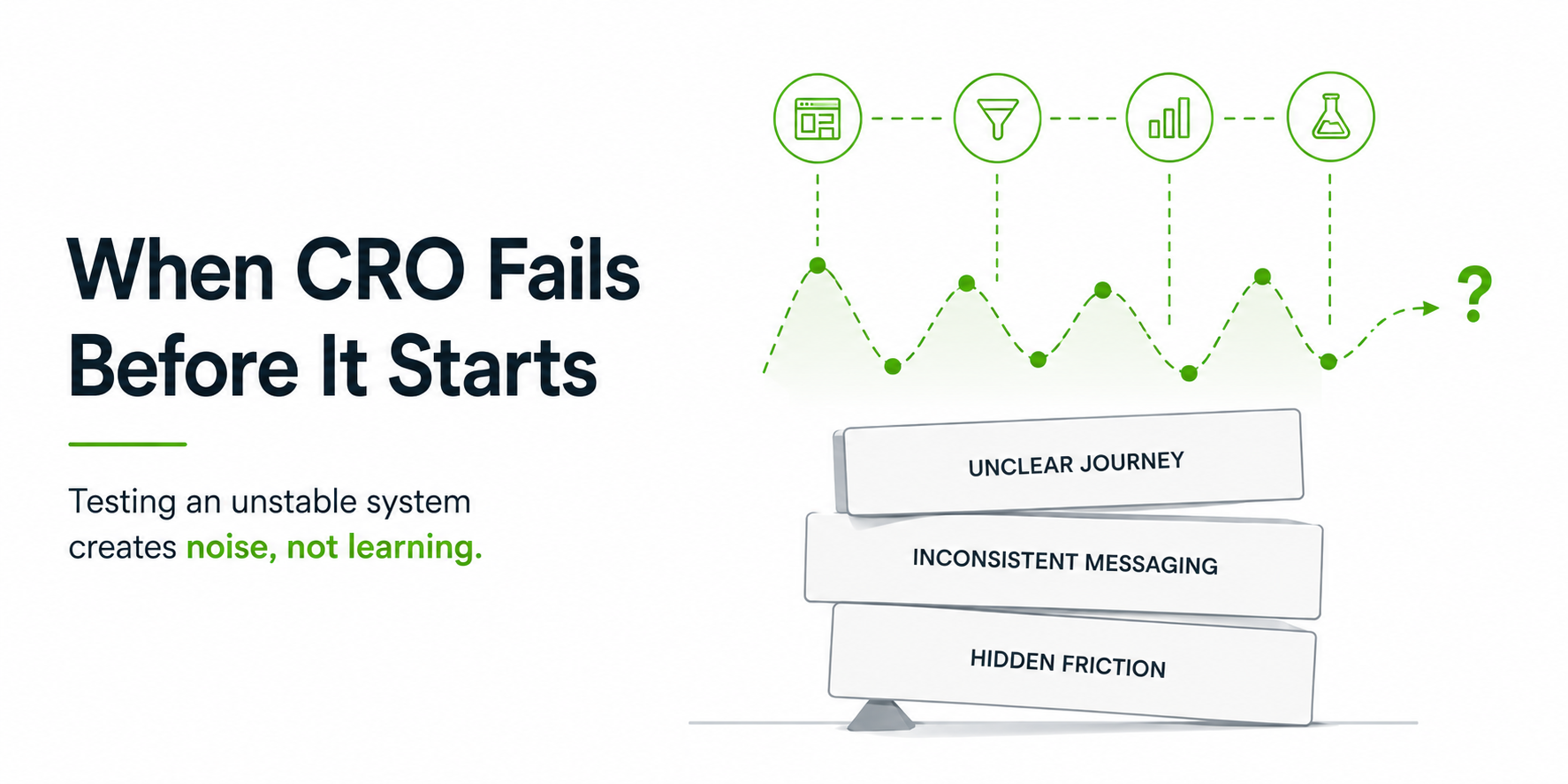
CRO isn’t failing. It’s being applied to a system that isn’t ready for it.
1. CRO Assumes a Stable System — Most Funnels Aren’t
Every experiment relies on a basic assumption: that the system being tested is stable enough to produce reliable signals.
This means:
— Users understand the journey
— Decision paths are clear
— Behavior is relatively consistent
When these conditions hold, small changes can produce meaningful differences. You can isolate variables. You can trust results. You can learn.
But most real-world funnels don’t operate like this.
They contain:
— Unclear transitions between steps
— Inconsistent messaging across pages
— Friction that affects different users in different ways
In such environments, user behavior becomes unpredictable. And when behavior is unstable, experimentation loses its foundation.
2. Structural Issues Distort Test Outcomes
When CRO is applied on top of unresolved structural problems, results become misleading.
A variation may perform better — not because it improves the experience, but because it accidentally compensates for an underlying flaw.
Another test may fail — not because the idea is weak, but because a larger issue is suppressing its impact.
This is where many teams draw the wrong conclusions.
TEAM ASSUME
✕ “This idea didn’t work”
✕ “Users don’t respond to this change”
IN REALITY
→ The system is distorting the signal
Without a stable foundation, tests don’t clarify reality. They obscure it.
3. Testing Becomes Activity Instead of Learning
Once signal quality drops, the nature of experimentation begins to change.
Instead of building insight, teams begin to chase outcomes.
— More tests are launched in an attempt to “find something that works.”
— Hypotheses become broader, less precise.
— Results are interpreted more loosely.
This creates a cycle:
- Run test
- Get unclear result
- Run another test
Over time, volume increases — but understanding does not. What should be a structured learning system turns into a sequence of disconnected attempts.
This is where CRO starts to feel ineffective, even though the issue is not the method, but the context in which it is being applied.
4. Volume Replaces Prioritization
As confidence in results declines, teams often respond by increasing the number of experiments.
The assumption is simple: 👉 More tests will eventually produce better outcomes
But without clear prioritization, this approach spreads effort thin.
— High-impact opportunities are treated the same as low-impact ones.
— Tests are not sequenced logically.
— Learning does not build from one experiment to the next.
Even broader industry observations from HubSpot show that structured, hypothesis-driven experimentation consistently outperforms high-volume, unstructured testing.
“CRO is not a numbers game. It is a thinking discipline.
And without structure, more activity only accelerates confusion.”
5. The Real Issue: The Funnel Isn’t Ready to Respond
At its core, CRO depends on responsiveness.
When you introduce a change, the system should react in a way that reflects user behavior and intent.
If the funnel is clear, even small improvements can produce measurable gains.
But when the funnel lacks clarity:
— Users interpret experiences differently
— Decision-making becomes inconsistent
— Changes produce uneven results
In such systems, experimentation does not fail outright. It produces noise. And noise cannot be optimized.
6. What Needs to Be True Before CRO Can Work
Before experimentation becomes effective, certain conditions need to be in place. Not as best practices — but as prerequisites.
The funnel must:
✓ Guide users clearly from one step to the next
✓ Align messaging with user intent across touchpoints
✓ Minimize friction at key decision points
✓ Produce relatively consistent behavior patterns
These conditions don’t guarantee success. But without them, success becomes unreliable.
This is why jumping into testing too early often leads to wasted effort. The system is not yet capable of producing meaningful feedback.
7. The Right Sequence: Clarity Before Experimentation
Instead of starting with tests, the sequence needs to shift.
- First, understand how the funnel works as a system.
- Then, identify structural issues and constraints.
- Then, define what matters most.
- Only then, begin experimentation.
This is where:
play a critical role.
They don’t replace CRO. They make CRO effective.
FINAL THOUGHT
CRO does not fail because testing is flawed. It fails because the system being tested is not ready.
When user behavior is inconsistent, results cannot be trusted. When results cannot be trusted, learning breaks down. And when learning breaks down, optimization becomes guesswork.
But when the system is clear, experimentation works as intended. Not as a source of activity — but as a source of insight.