
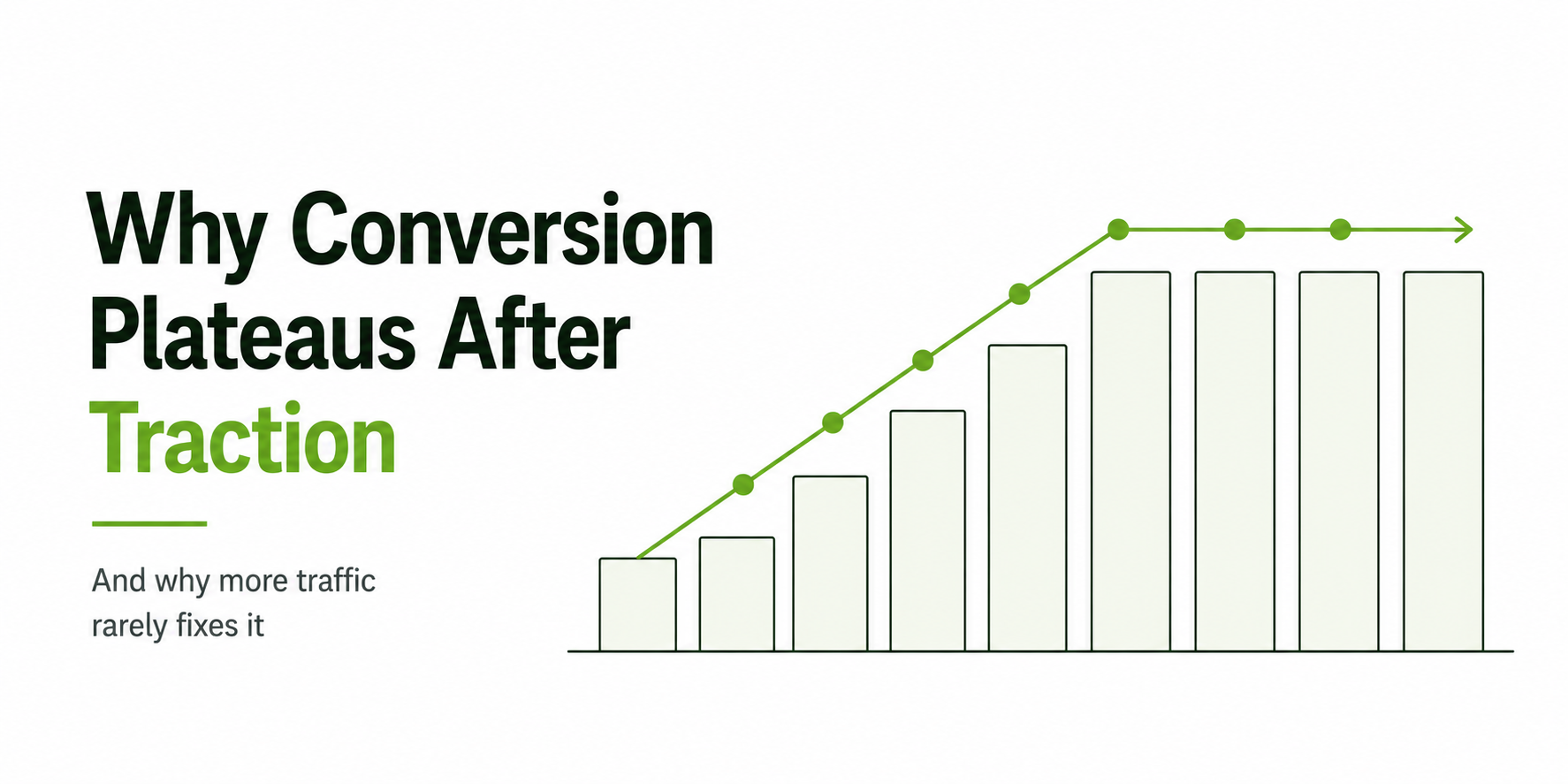
For many e-commerce teams, early growth creates a sense of momentum that feels predictable.
Traffic begins to scale. Acquisition channels start delivering. Conversion rates, while not perfect, are strong enough to justify continued investment.
At this stage, the assumption is simple: if traffic continues to grow, performance will follow.
But then something changes.
Traffic remains steady—or even increases—but conversion stops improving. In some cases, it begins to decline. Teams respond by increasing effort: more campaigns, more experiments, more optimization.
Yet nothing seems to move meaningfully.
This is the point where most teams misread the situation. What looks like a performance slowdown is not a failure of effort. It is a signal that the system itself has reached its limit.
Pateau Is Not a Performance Issue. It Is a System Response.
In the early stages of growth, funnels often perform well despite underlying weaknesses.
A smaller audience tends to have higher intent. These users are more willing to tolerate friction, navigate ambiguity, and invest effort into completing a purchase. The journey does not need to be perfect—it only needs to be “good enough.”
As traffic scales, this changes.
You begin to see a wider range of users:
Different Levels of Intent
Not all visitors are ready to buy — intent varies widely as your audience grows
Different Expectations
Each segment arrives with a different frame of reference and set of assumptions
Lower Tolerance for Confusion
Broader audiences disengage faster — friction that was tolerable before now drives drop-off
What once worked under ideal conditions is now being tested under real conditions. And this is where the funnel begins to break—not visibly, but structurally.
Why the Plateau Happens: Structural Issues Beneath the Surface
One of the reasons conversion plateaus are difficult to diagnose is that they rarely stem from a single, obvious issue.
Most funnels evolve over time. New pages are added. Messaging shifts. Campaigns are layered. Product catalogs expand. Each decision makes sense in isolation, but together they create a journey that lacks coherence.
Users don’t experience this as a major failure. They experience it as subtle resistance.
These moments are easy to overlook individually. But across a journey, they compound.
Research from Nielsen Norman Group shows that even small increases in cognitive load reduce decision confidence and slow user progression. When users are required to think more than necessary, they don’t engage more deeply – they disengage.
This is what creates the plateau: not one broken element, but a system that gradually loses clarity.
Why More Traffic Makes the Problem Worse
When conversion stalls, increasing traffic feels like a logical next step. If performance is flat, more visitors should produce more revenue.
But this assumes that the funnel behaves consistently regardless of who enters it.
In reality, scaling traffic introduces variability:
A funnel that lacks clarity cannot handle this variability. Instead of improving results, scale exposes weaknesses. Friction that once affected a small percentage of users now impacts a much larger group. Small inefficiencies become consistent sources of loss.
Even technical factors begin to matter more at scale. Studies from Google have shown that small delays in page load time can significantly reduce conversion rates, particularly on mobile devices.
At low volume, these issues are easy to ignore. At higher volume, they become impossible to sustain.
This is why many teams see efficiency decline as traffic increases. The problem is not the audience. The problem is the system’s inability to support them.
Where Funnels Quietly Break: Misalignment and Momentum Loss
Beyond friction, another structural issue begins to surface as funnels scale: misalignment.
Every traffic source creates an expectation. Ads promise a benefit. Emails frame a value proposition. Landing pages suggest relevance.
When users arrive on-site, they are looking for confirmation. If the experience immediately reinforces that expectation, momentum builds. If it doesn’t, momentum breaks.
This break is subtle but critical. Users pause to reassess. They re-evaluate whether they are in the right place. And in many cases, they leave—not because the offer is weak, but because the experience feels inconsistent.
This kind of misalignment rarely appears clearly in analytics. It doesn’t always show up as a single drop-off point. Instead, it spreads across the journey as hesitation.
“And hesitation is what slows conversion at scale.”
Why More Effort Stops Working
At this stage, most teams respond by increasing activity. More campaigns. More tests. More iterations.
But when the underlying system lacks clarity, effort does not compound—it fragments. Improvements made in one part of the funnel are offset by friction in another. Tests produce results, but not direction. Gains are temporary and difficult to replicate.
This is why optimization often feels inconsistent at this stage. It’s not because teams are doing the wrong things. It’s because they are working on the wrong level of the problem.
What Actually Needs to Change
Breaking a plateau does not require more activity. It requires a shift in focus.
Instead of asking: “What should we test next?”
The better question is: “How is this funnel actually working as a system?”
This means understanding:
→Where users lose confidence
→Where decisions become unclear
→Where momentum slows or breaks
Only once these structural issues are identified can optimization become effective.
This is the role of a → Funnel & Journey Audit — not to generate a long list of observations, but to identify the few constraints that are limiting the entire system.
When clarity is restored, improvements begin to compound. Changes produce predictable outcomes. Growth becomes more efficient—not because more effort is applied, but because the system is finally able to respond to it.
FINAL THOUGHT
A conversion plateau is not a sign that growth has stopped. It is a signal that the current system is no longer supporting it.
Until that system is clarified, more traffic will only make inefficiency more expensive.
But once clarity is restored, growth doesn’t need to be forced. It begins to respond again.