
Run experiments, measure results, scale what works — in theory, it creates a steady path to growth. Most teams adopt testing with this expectation, believing that more experiments will naturally lead to better performance.
But in practice, the experience is often different.
Tests run, but results are unclear. Some experiments show marginal improvements, others contradict each other, and even successful tests fail to produce consistent follow-through gains. Over time, testing becomes something teams do regularly, but learn from inconsistently.
At that point, the question shifts.
Not “What should we test next?” But “Why aren’t we learning anything meaningful?”
Why Testing Isn't the Problem — The System Is
For this to work, the system needs to behave in a relatively stable and predictable way. When users interact with the funnel consistently, even small changes can produce clear, interpretable results.
But most funnels are not stable systems.
They contain inconsistencies in how users understand, navigate, and move through the journey. These inconsistencies are not always obvious, but they affect how users respond to changes.
Why Testing Breaks When the Funnel Isn't Clear
This typically unfolds in a predictable way:
1
Testing Assumes a Stable System
Without this stability, it becomes difficult to determine whether a result is caused by the variation or by differences in user behavior.
2
Unclear Funnels Create Inconsistent Behavior
Some understand the product immediately, others require more effort. Some move forward confidently, while others hesitate or drop off earlier. Even small differences in interpretation can lead to very different behaviors.
This variability makes it difficult to isolate the impact of any single change.
3
Inconsistency Turns Results Into Noise
You may see:
— Inconclusive outcomes where neither variation clearly wins
— Conflicting results across similar tests
— “Winning” variations that fail to replicate over time
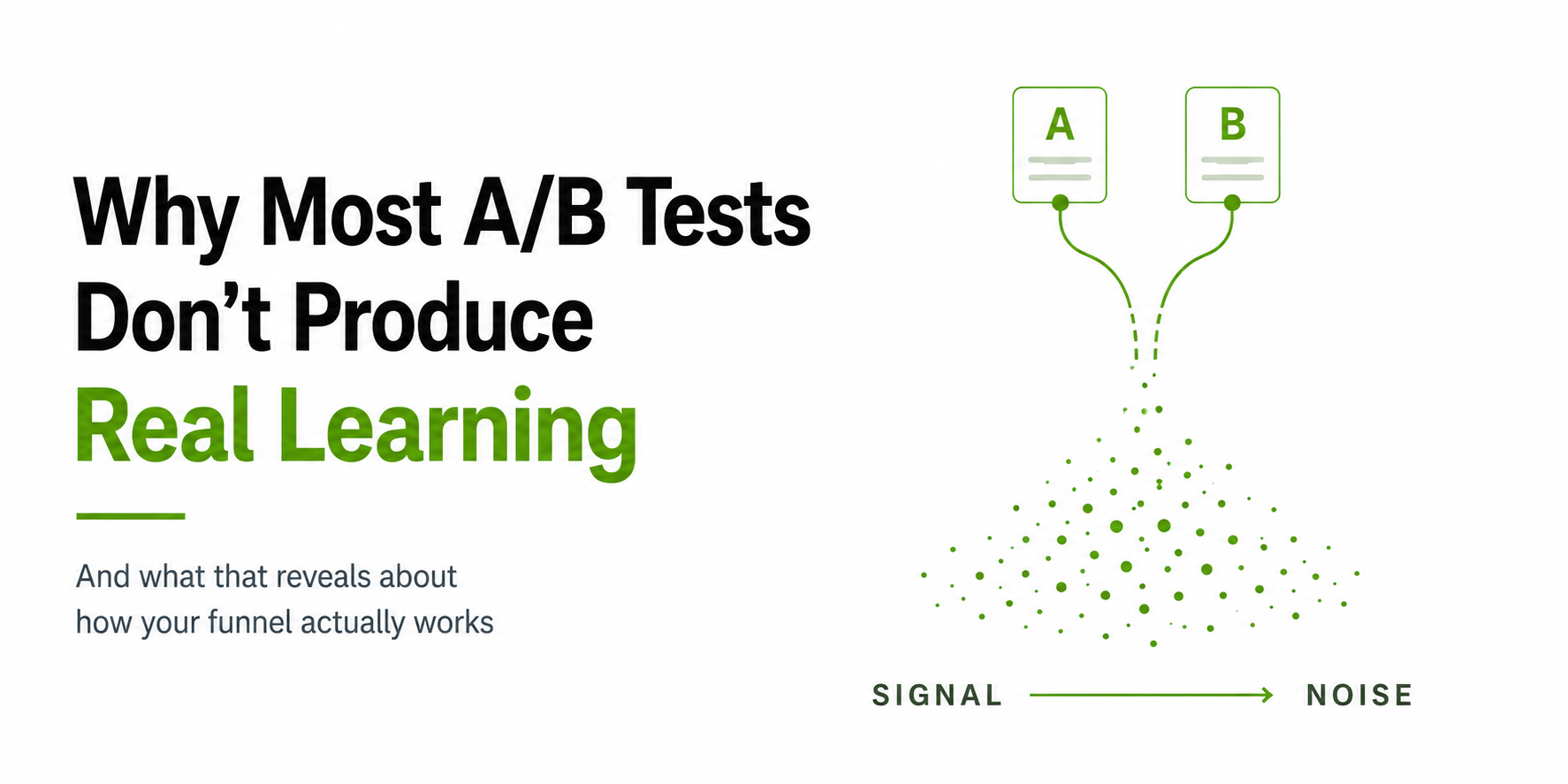
At this point, testing stops producing insight. It produces noise. And noise cannot be optimized.
Why Unclear Funnels Turn Testing Into Noise
NOISE
Noise represents random variation — changes that appear significant but are not reliably tied to the variation being tested.
SIGNAL
Signal represents a meaningful pattern — a clear indication that a change has influenced behavior in a predictable way.
In a clear, well-structured funnel, user behavior is consistent enough for signal to emerge. Differences between variations reflect actual changes in how users respond.
In an unclear funnel, behavior is fragmented. Users interpret pages differently, move through different paths, and respond inconsistently to the same experience.
Why More Testing Makes This Worse
The assumption is that increasing the volume of experimentation will eventually produce clearer answers.
In reality, the opposite often happens.
More tests introduce:
More variables introduced across the system
More conflicting data that’s harder to interpret
More difficulty in reading results and drawing conclusions
What Testing Is Actually Meant For
It works best when:
✓ The funnel already supports clear decision-making
✓ User behavior is relatively consistent
✓ The goal is to improve specific aspects of an already functioning system
“Testing is not about finding what works. It is about improving what already works.”
What Needs To Be True Before Testing Works
The funnel must:
✓ Guide users clearly from one step to the next
✓ Align messaging with user intent across touchpoints
✓ Minimize friction at key decision points
✓ Produce consistent patterns of behavior
What This Means for Your Funnel
It may lie in how your funnel works as a system.
Understanding this requires looking beyond individual tests and examining how users experience the journey as a whole — where clarity breaks down, where behavior diverges, and where consistency is lost.
Only then does it become possible to create the conditions in which testing can actually work.
FINAL THOUGHT
It fails because the system it operates on is unclear.
When user behavior is consistent, testing produces insight. When it is not, testing produces noise.
And the difference between the two is not the number of experiments you run.
It is the clarity of the funnel you are testing.