
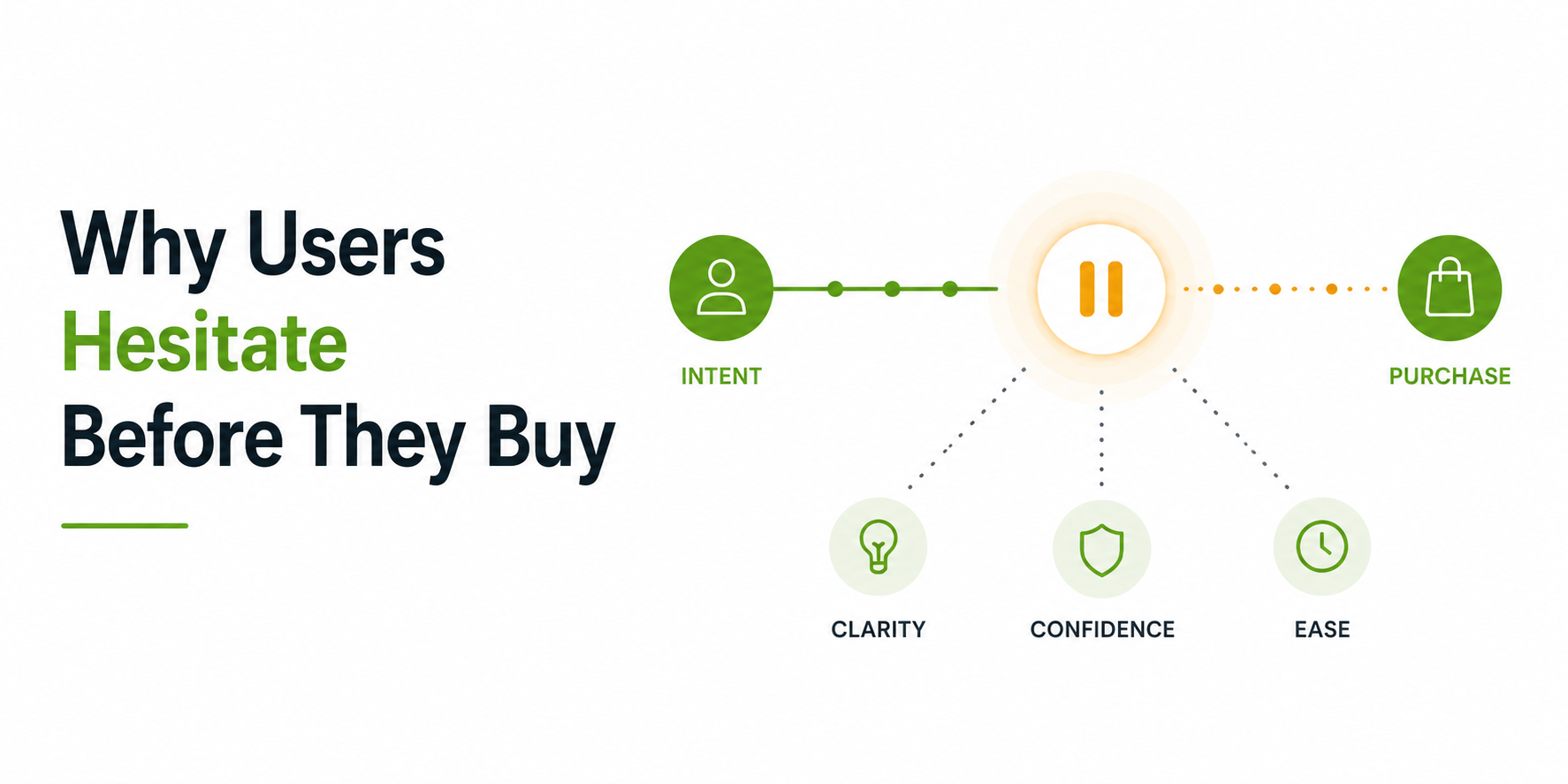
Users Are Clearly Interested.
They are browsing products, spending time on pages, even adding items to cart.
And then… nothing happens.
They don’t convert.
At first glance, this feels confusing. If intent is high, why isn’t action following?
The usual explanations tend to focus on traffic quality or pricing. But in many cases, neither is the real issue.
When Intent Is High, Hesitation Becomes the Real Problem
At low intent, the challenge is straightforward — users are not convinced enough to engage.
But at high intent, the problem shifts.
Users are already considering a purchase. They are evaluating, comparing, and moving through the funnel. The question is no longer “Do they want this?” but “What’s stopping them from acting?”
What Hesitation Actually Looks Like in a Funnel
You might see users:
↻ Scrolling through a product page multiple times without taking action
↩ Clicking into product details, then returning to listings
✕ Reaching checkout, then abandoning midway
↻ Re-reading sections of content, looking for reassurance
⏸ Adding items to cart, but delaying the next step
Why Users Hesitate Even When They Want to Buy
1. They Don’t Feel Clear Enough to Move Forward
Clarity is one of the most underestimated drivers of conversion.
Even when users are interested, they often pause if they are unsure about:
— Whether the product is right for them
— How it compares to alternatives
— What exactly they are getting
This is especially common in funnels where:
— Product positioning is vague
— Information is scattered across the page
— Too many options are presented without guidance
Research from Nielsen Norman Group shows that users do not engage more deeply when faced with complexity — they disengage. When users have to work to understand something, they are more likely to pause than proceed.
The objective is not to surface a long list of issues, but to identify the few problems that directly impact conversion.
At high intent, even small gaps in clarity can create hesitation.
2. They Don’t Feel Confident Enough to Commit
Beyond understanding, users need to feel confident in their decision.
This is where trust and reassurance come in.
Hesitation often appears when users are thinking:
— “What if this doesn’t work for me?”
— “Can I trust this brand?”
— “Is this worth the price?”
These concerns are rarely dramatic. They are subtle, but they are enough to delay action.
For example, a product page may be well-designed but lack:
— Clear proof points
— Credible reviews
— Transparent policies
3. The Process Feels Heavier Than Expected
Even when users are clear and confident, the effort required to complete the journey can introduce hesitation.
This is especially visible in later stages of the funnel.
Users may encounter:
— Too many form fields in checkout
— Unexpected steps or redirects
— Slow-loading pages or interruptions
Individually, these may seem minor. But together, they increase perceived effort.
According to research by Baymard Institute, unnecessary complexity in checkout is one of the leading contributors to cart abandonment across e-commerce.
The objective is not to surface a long list of issues, but to identify the few problems that directly impact conversion.
Why Hesitation Doesn’t Show Up Clearly in Data
One of the reasons hesitation is often overlooked is that it doesn’t always appear clearly in analytics.
From a data perspective, users who hesitate may look engaged:
— They spend time on pages
— They interact with elements
— They move partially through the funnel
The Compounding Effect of Hesitation
Hesitation is rarely caused by a single issue.
More often, it is the result of multiple small moments of friction and uncertainty across the journey.
— A slight lack of clarity on the product page.
— A small trust gap in messaging.
— A bit of extra effort in checkout.
Individually, these may not seem critical. But together, they create a pattern of hesitation that slows users down at every step.
“Users don’t drop off because of one major problem. They disengage because the journey never feels easy enough to complete.”
Where Most Teams Get This Wrong
They:
WHAT TEAMS DO
→ Add urgency (“Limited time offer”)
→ Introduce more discounts
→ Increase promotional messaging
→ More clarity
→ More confidence
→ Less effort to complete the process
While these tactics can create short-term lifts, they don’t address the root issue.
If users are hesitating because of uncertainty or friction, adding pressure does not resolve the hesitation. In some cases, it amplifies it.
What Actually Reduces Hesitation
In practice, this means:
✓ Ensuring product value is immediately clear and easy to understand
✓ Providing the right level of reassurance at the right moments
✓ Structuring the journey so users always know what to do next
✓ Removing unnecessary steps or effort from the process
What This Means for Your Funnel
If users are hesitating despite high intent, the issue is not demand.
It is how the journey supports decision-making.
Understanding where and why hesitation occurs requires looking beyond surface metrics and examining how users experience the funnel as a whole.
This is where a → Funnel & Journey Audit becomes valuable. Not as a checklist of issues, but as a way to understand how clarity, confidence, and effort interact across the journey.
FINAL THOUGHT
Users don’t hesitate because they aren’t interested.
They hesitate because something doesn’t feel resolved.
And until that is addressed, no amount of traffic or promotion will fully close the gap between intent and action.